Blog
The Hidden Cost of Poor SEO for Dubai SMEs: Missed Leads & Revenue

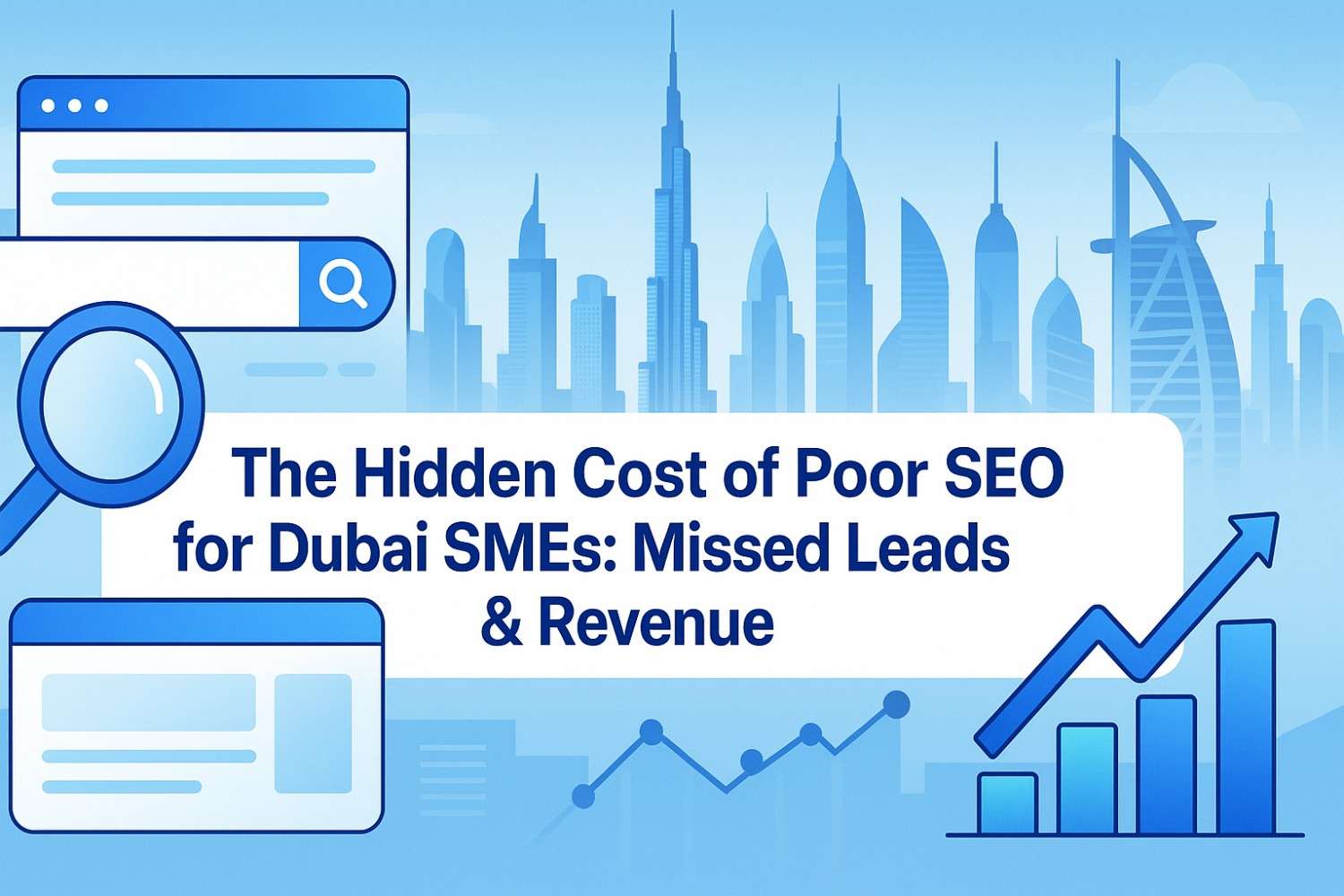
In Dubai’s hyper-competitive business ecosystem, being visible online is not just a nice-to-have — it’s essential. For small and medium enterprises (SMEs) in Dubai, poor SEO (Search Engine Optimization) isn’t simply a missed strategy; it often means lost leads, missed revenue, and weakening market position. While many Dubai SMEs invest in social media ads or traditional marketing, neglecting SEO holds deeper hidden costs that manifest gradually — by the time you notice, you may already be trailing behind competitors.
This article dives into those hidden costs, gives Dubai-specific examples and data, and shows how SMEs can reverse the damage. It also answers voice-search–friendly queries Dubai business owners may ask, so your content can serve both Google and voice/AI assistants.
Why SEO matters for Dubai SMEs (and what “poor SEO” really means)
Dubai’s digital market context: fast, saturated, and opportunity-rich
-
SMEs account for 95% of Dubai’s business population, and contribute around 40% of value added and 43% of workforce.
-
The UAE digital media market generated USD 8,288.5 million in 2023, and is expected to more than double by 2030.
-
As of 2025, many UAE businesses are shifting budgets away from Meta (Facebook, Instagram) ads towards sustainable digital strategies like search and content, because of declining ROI on paid platforms.
-
Arabic localization is rising: in 2023, only ~30% of UAE businesses prioritized Arabic SEO — by 2025, that is projected to rise above 50% as brands recognize the importance of multilingual content.
In this environment, competition for high-intent keywords like “best accounting firm in Dubai,” “Dubai office fit-out contractors,” or “SME digital marketing Dubai” is fierce. A business that fails to optimize is invisible when your ideal clients are searching.
What does “poor SEO” look like?
Poor SEO isn’t necessarily no SEO at all. Some common signs include:
-
Poor keyword targeting (focusing on very generic terms rather than “Dubai + niche”)
-
Weak content (thin pages, lack of relevance, duplicated content)
-
Technical issues (slow site, broken links, no mobile optimization, poor site structure)
-
Weak local SEO: no Google Business Profile, no local citations, not optimized for “near me” searches
-
No link building or low-quality inbound links
-
Lack of conversion optimization — even traffic you get doesn’t convert
When these issues persist, the costs hide behind the scenes.
The hidden cost #1: Missed leads & opportunities
Loss of organic traffic = loss of potential customer journeys
Each month, people in Dubai and the UAE search for services, products, solutions. If your website isn’t ranking for relevant keywords, your potential leads never find you—they find your competitors instead.
Let’s say your SME is a boutique HR consultancy in Dubai. Keywords like “HR consultancy Dubai,” “Dubai recruitment firm,” “HR outsourcing UAE” are searched monthly. If your firm ranks on page 3 or lower, your clicks (and leads) evaporate. You miss not just one client but dozens monthly over time.
Where does that traffic go? To your competitors, to directories, to agencies who did optimize well.
Poor SEO forces overreliance on paid channels
Because you’re invisible organically, you compensate via costly paid search and social ads. But paid traffic stops when budgets stop. Over time that means unsustainable cost per lead (CPL), and worse ROI.
Many Dubai SMEs report that they rely heavily on ad spend, because their organic visibility is weak.
Case in point: Lost leads due to poor lead handling in Dubai
It’s not just visibility — even if people find you, poor SEO often couples with weak UX or missing lead capture. A LinkedIn post notes that many Dubai businesses lose revenue not because they lack leads, but because they mishandle them: slow followups, broken forms, unclear calls to action.
Combine that with low organic visibility, and you’re losing leads at both ends.
The hidden cost #2: Wasted marketing budgets & lower ROI
Paying for what could be free
Every dirham you spend on ads, social media campaigns, or directories is partially compensating for what SEO should be generating organically. Over a year, those costs add up.
In Dubai, SEO services cost between AED 1,500 and AED 15,000+ per month, depending on scale, competition, and service provider.
If you spend AED 8,000/month on ads because SEO is failing, that’s AED 96,000/year. If just half of that was sustainable organic traffic you could get with proper SEO, you’re effectively wasting resources.
Lower conversion rates from poor landing optimization
SEO without conversion rate optimization (CRO) is like driving people into a leaky bucket. An optimized SEO funnel ensures that messy onboarding, slow pages, vague CTAs don’t kill your lead conversion. In Dubai’s cutthroat markets, every extra conversion matters.
A Dubai agency emphasizes that SEO and CRO must be integrated — high rankings must translate to real business outcomes.
Brand erosion & credibility cost
In markets like Dubai, where consumers are discerning and trust is important, appearing on page 1, with good content and fast performance, signals professionalism. A site that ranks poorly, loads slowly, or looks outdated projects an image of neglect. Over time that erodes brand trust — making even referrals hesitate.
The hidden cost #3: Missed growth and scalability
Slower expansion across Emirates or to clients abroad
Suppose your SME wants to expand from Dubai to Abu Dhabi, Sharjah, or even GCC-wide. Without a strong SEO base, you’ll struggle to get traction in new location keywords like “Abu Dhabi cloud services,” “Sharjah interior designer,” or “GCC B2B SaaS provider.” Your site’s authority remains local and limited.
Organic presence builds a scalable foundation; paid always has a ceiling.
Falling behind competition in your niche
If your competitor invests in SEO and outranks you steadily, they siphon inbound leads, build topical authority, and gain better link equity over time. You become the “also-ran.” In Dubai sectors like construction, fintech, hospitality, real estate, the SEO gap widens fast.
Opportunity cost in cross-selling, content marketing, and passive revenue
A well-optimized site enables content marketing, lead magnets, SEO-driven funnels, remarketing, and passive conversions. Without SEO, you miss these strategic growth levers
Quantifying the cost: Examples & estimation models
Hypothetical model: Estimating lost revenue
Let’s run a ballpark model for a mid-tier Dubai SME:
| Metric | Estimate | Explanation |
|---|---|---|
| Searchable keywords (Dubai) | 200 high-intent, low-medium difficulty | e.g. “Dubai X services,” “X solutions UAE” |
| Expected CTR on page 1 (average) | 20% | If you rank in top slots |
| Monthly searches per keyword (average) | 200 | multiplied by 200 keywords = 40,000 total searches |
| Potential visits | 8,000 | 20% of 40,000 |
| Conversion rate | 2% | conservative for lead gen |
| Leads per month | 160 | |
| Average deal value | AED 5,000 | depends on business |
| Monthly revenue potential | AED 800,000 | |
| Realized via poor SEO (assuming you get top 100 ranking) | 5% | only small fraction via generic or branded search |
| Revenue you actually get | AED 40,000 | |
| Unrealized (lost) revenue | AED 760,000 / month |
Even if this is optimistic, multiply by 12 → over AED 9 million/year of missed opportunity. In many cases the gap is lower, but the proportional impact is large.
Real-world anecdotal comparators
While specific public case studies in Dubai are rare, global SEO studies often show that not investing in SEO can cost firms tens or hundreds of thousands over a few years. For example, one analysis showed a business lost USD 216,000 over three years by not investing in SEO.
In Dubai, given high competition and higher average deal sizes, the scale of missed opportunity is even greater.
Common SEO pitfalls among Dubai SMEs (and how to fix them)
1. Neglecting local SEO and “near me” searches
Many Dubai SMEs treat SEO in a generic sense, ignoring location-based optimization:
-
Lack of Google Business Profile (GBP) or not optimizing it
-
Not building local citations (Dubai Chamber directory, local trade bodies)
-
Missing out on geo modifiers (“near me Dubai,” “in Jumeirah,” “in Business Bay”)
-
Forgetting to include area pages (e.g. “Servicing Dubai Marina,” “serving Jebel Ali”)
Fix: Claim and optimize your GBP with accurate NAP (name, address, phone), encourage reviews. Create service-area pages. Use local schema. Build listings in UAE directories.
2. Weak multilingual / Arabic content strategy
In Dubai’s multicultural market, many businesses produce content only in English. But a large segment of consumers and businesses use Arabic search terms.
-
In 2023, only ~30% of UAE businesses prioritized Arabic SEO; by 2025 that figure may exceed 50%
-
Arabic keywords often have less competition, offering an easier entry.
-
But translation must be high-quality and SEO-aware (not machine translated).
3. Poor technical SEO, performance, and mobile issues
Common technical problems include:
-
Slow page load times (especially on mobile)
-
Non-optimized images, no lazy loading
-
Broken internal links, missing redirects
-
No SSL / insecure site
-
Poor mobile usability
-
Duplicate content (especially with category pages or pagination)
Google’s Core Web Vitals and page experience metrics penalize poorly performing sites. A slow site in Dubai may dissuade prospective clients searching on mobile.
4. Weak content strategy and targeting
Many SMEs create content that’s generic, unfocused, or doesn’t match searcher intent.
-
Content not aligned with questions people ask (“What is cost to set up free zone in Dubai?”)
-
Thin landing pages with little depth
-
No pillar clusters or topic clusters
-
Little internal linking strategy
Fix: Use keyword research (Dubai + niche). Structure content with questions, FAQs, schema. Build clusters of content around core service topics.
5. Low domain authority / link profile
Without quality backlinking, your site struggles to compete. Some SMEs may:
-
Rely on low-quality or directory links
-
Fail to pursue partnerships for guest posts
-
Have no PR or local citations linking back
In Dubai, link equity can come from media outlets, Dubai business blogs, local trade associations, or sponsorships.
Dubai-specific examples & sector nuances
Real estate and property services
In Dubai, keywords like “buy apartment in Dubai Marina,” “property management in JLT,” “off-plan developer Dubai” are highly competitive. A real estate SME lacking strong SEO will struggle to compete with big developers.
Also, many Dubai property searches are voice-based (e.g. “Alexa, find apartments in Dubai near me”) — so long-tail voice queries must be targeted.
Hospitality, retail, and shopping
Dubai’s tourism and retail landscape is intense. If your boutique store, restaurant, or hotel doesn’t rank for “best café in Downtown Dubai” or “luxury boutique in City Walk,” you lose footfall and reservations to competitors.
Professional services (law firms, consultancies, accounting)
These niches thrive on trust and authority. Ranking highly for “Dubai business setup consultancy,” “free zone incorporation Dubai,” or “audit firm in UAE” is high-value. Poor SEO here is especially costly because clients often search directly before contacting.
E-commerce businesses in Dubai
Dubai e-commerce is booming, but the competition is stiff. Studies note that e-commerce businesses in Dubai must optimize category pages, product pages, site structure, mobile UX, and local search to succeed. A site that lacks SEO will see low traffic and high bounce rates.
E-commerce firms often rely too heavily on advertising; but without SEO, long-term visibility is weak.
How to calculate your “SEO debt” and prioritize action
Step 1: Audit where you stand
-
Use tools (e.g. Ahrefs, SEMrush, Google Search Console) to identify top-ranking missed keywords, pages with traffic drops, errors, and backlink gaps
-
Analyze site speed, mobile usability, Core Web Vitals
-
Review your local citations and GBP presence
-
Check content gaps — where your competitors rank and you don’t
Step 2: Estimate opportunity value
-
For each keyword you could potentially rank higher, estimate monthly search volume × CTR × expected conversion rate × average deal value
-
Sum up for 6–12 months to see total opportunity
-
Compare this against your current SEO/marketing spend
Step 3: Prioritize fixes by impact vs effort
| Priority | Focus Area | Expected Impact |
|---|---|---|
| High | Technical fixes (speed, mobile, broken links) | Improves core ranking, user experience |
| High | Local SEO & GBP optimization | Captures “near me” local searches |
| Medium | Content strategy / clusters / voice queries | Boosts long-tail traffic |
| Medium | Backlink outreach, digital PR | Builds domain authority |
| Low (but ongoing) | Multilingual content expansion, content refresh | Sustains growth and coverage |
Step 4: Monitor, measure, and iterate
-
Use KPI dashboards: organic traffic, keyword rank improvements, leads from organic source, conversion rates
-
Set quarterly goals
-
Adjust content strategies based on data
Voice & AI assistant optimization: thinking like Alexa, Siri, Google Assistant
To win in voice/AI-driven search, Dubai SME content must be conversational, question-based, and contextual. Here are some tactics:
Use question-based headings and FAQs
For example:
-
“What is the cost to start a business in Dubai free zone?”
-
“How long does visa processing take in Dubai?”
-
“Which SEO services are best for Dubai SMEs?”
These can match voice queries like “Hey Siri, what’s the cost to incorporate in Dubai?”
Structure content with short answers + detail
Voice assistants often pull the first succinct answer (40–60 words). So begin FAQ answers with brief, direct answers, followed by supporting details.
Use schema markup / FAQ schema / Q&A schema
Mark up your content so voice engines can surface your answers in rich results.
Target long-tail conversational queries
Examples:
-
“How to improve local SEO in Dubai?”
-
“Is SEO worth it for a restaurant in Dubai?”
-
“SEO cost per month UAE?”
-
“SEO company for SMEs in Dubai”
Include those naturally in content.
Location signals and context
Embed localized language (e.g. “in Dubai,” “UAE,” “Jumeirah,” “Palm Jumeirah,” “Business Bay”) to signal geo relevance. Use phrases like “close to me,” “near,” “in my area (Dubai).”
Overcoming common challenges for Dubai SMEs
Budget constraints
Many SMEs worry SEO is expensive. But SEO should be viewed as a long-term investment, not a cost. Even a phased approach (technical fixes first, content later) can begin showing results.
Compare the monthly SEO cost (AED 1,500–15,000) with the potential revenue uplift we modeled. The ROI can be substantial.
Talent and knowledge gap
Not every SME has in-house SEO expertise. Options:
-
Hire a Dubai-based SEO agency familiar with UAE search context
-
Outsource to trusted freelancers
-
Invest in training or hire a digital marketing manager
Given the demand, Dubai has many professionals in digital marketing roles.
Keeping up with algorithm changes & competition
SEO is not a one-off. Algorithms, competitive landscapes, and search trends evolve (especially with AI). Maintain content refresh cycles, monitor analytics, and adjust.
Local constraints & regulatory issues
Be aware of UAE regulations regarding content, media licensing, influencer advertising, etc. Also, ensure your site complies with UAE data protection rules.
Example roadmap: SEO recovery plan for a Dubai SME
-
Technical audit & fixes (month 1–2): speed optimization, mobile fixes, SSL, broken links, site structure
-
Local setup (month 2–3): Google Business Profile, local citations, NAP consistency
-
Keyword & content plan (month 3–4): research Dubai-specific, long-tail, voice queries
-
Content creation & optimization (month 4–6): pillar pages, service pages, FAQ sections
-
Backlink & outreach (month 5–8): guest posts, PR, partnerships with Dubai media/blogs
-
Multilingual expansion (after 6 months): launching Arabic content, localized pages
-
Continuous measurement and iteration (ongoing): adjust based on data
Even by month 3–4 you may begin seeing upticks in impressions, clicks, and leads.
Frequently Asked Questions (for voice & AI optimization)
Q: What is the cost of SEO for SMEs in Dubai?
A: For SMEs in Dubai, monthly SEO cost typically ranges between AED 1,500 and AED 15,000+, depending on competition, scope, and agency expertise.
Q: How long does it take to see results from SEO in Dubai?
A: Typically 3 to 6 months for noticeable rankings and leads, and 6–12 months for impact to solidify. The timeline depends on niche competition, site condition, and resources.
Q: Is SEO worth investing in for small businesses in Dubai?
A: Yes — because SEO builds sustainable visibility, reduces dependency on paid ads, and captures high-intent leads over time. The hidden cost of not doing it (lost leads and revenue) often far outweighs the investment.
Q: Do I need Arabic SEO if my business is in Dubai?
A: Yes, particularly as more consumers use Arabic queries. Many companies are now prioritizing Arabic SEO to reach Arabic-speaking audiences.
Q: Can SEO failures kill my brand reputation?
A: Indirectly, yes. A slow, poorly ranking, or non-mobile site projects poor professionalism, eroding trust with visitors, partners, and potential clients.
The hidden costs of poor SEO for Dubai SMEs are real and significant: lost leads, wasted marketing budgets, slower growth, and eroding brand credibility. In Dubai’s dynamic and competitive digital marketplace, the difference between ranking well and being invisible often determines survival.
But the path forward is clear: invest in an integrated, locally relevant SEO strategy — starting with technical auditing, local SEO, content and voice-based content, and consistent measurement. Even incremental improvements compound over time.
If you own a Dubai SME and want help auditing your SEO, estimating your missed opportunity, or building a recovery plan tailored to Dubai’s market — reach out. Let’s turn your “SEO debt” into a growth engine.